Introduction
School mathematics often feels like a checklist of hundreds of disconnected procedures to be practised and then performed.
What if instead we could boil it all down to just five BIG IDEAS that connect everything together and are the key to understanding the whole?
This comprehensive and completely free website for teachers, written by Professor Colin Foster, does exactly that.
This Introduction explains the approach, and the following five chapters address each of the five BIG IDEAS in detail.
0.1 The problem of crowded curricula
In many countries across the world, school mathematics curricula are perceived as absurdly over-crowded with content. There is just so much for a teacher to teach in the limited time they have with their learners. And much of this content can be perceived as a list of ‘things they have to be able to do’, rather than a deep engagement with important and substantive ideas. Many mathematics lessons effectively begin with the teacher saying, “Here’s something else you need to be able to do”. And the lesson consists of the teacher demonstrating some prescribed technique, followed by the learners rehearsing it until they can perform it efficiently and successfully.1 A learner’s question “Why?” or “When will I ever need this?” may be unwelcome, not because the teacher does not know, or does not care about the bigger picture, but because there are just so many more techniques to get through in the very limited amount of teaching time available. Not covering everything by the end of the course could disadvantage the learners in high-stakes examinations, which in mathematics function as critical gatekeepers to future study. And this is particularly important for learners who are socioeconomically disadvantaged. So what else can the teacher do?
It is easy to understand why school mathematics curricula throughout the world seem so often to be structured in this kind of way. Further progress in mathematics often depends on developing a necessary level of fluency in ‘the basics’. For example, using algebra to solve problems can be powerful, but only if the learner is able to step back from the details of how to manipulate a string of symbols and focus on the larger problem. Without this level of fluency, the learner’s working memory is very likely to become overwhelmed with the details, so they are unable to rise above the technicalities and see the wood for the trees. So, if we are committed to setting up learners for future success, it seems essential to spend the time necessary to train them thoroughly in every procedure they might need to use.2
I see three main problems with this approach:
First, it takes a lot of time to get through all the curriculum content this way, because every individual process the learners need to be able to do has to be separately taught, and repeatedly reviewed, so they reach a solid level of performance and do not subsequently forget how to do it. A great deal of time has to be devoted to retrieval practice of previously learned content, otherwise it will be lost and have to be taught all over again.
Second, the learner’s motivation for getting on board with this programme relies on the satisfaction they will receive from mastering these individual skills, and eventual success in a high-stakes examination, which may be some years away. This will work for some learners, but not all, meaning that schools feel forced to resort to imposing unpleasant consequences on learners who fail to get with the approach. Mathematics becomes a chore that must be done, largely because the consequences of not doing it are worse.
Third, and for me most importantly, this approach to learning mathematics fails to convey to learners much of the real nature of doing mathematics. Under the usual system, learners who present as conscientious, and perhaps even enjoy learning lots of procedures, may well be successful in their school examinations. But even if they are, they may not leave with a positive and realistic view of what using mathematics in further STEM study or in a career could be like. Learning mathematics in a procedure-focused way is not at all typical of what doing mathematics is likely to look like beyond the artificial school environment.
Some argue that the solution to all this must be to slim down the school curriculum to make it more manageable. I sympathise with that, but I think that creates other problems. Instead, I prefer to consider how we can alter the way mathematics is taught in schools. Rather than attempt to separately train each one of these micro-skills to confident performance, endlessly practising them, so as not to forget how to do them, in this book I advocate a different, ‘big picture’ approach. Instead of viewing the teacher’s job as breaking down mathematics into tiny, digestible, bite-sized pieces (Figure 1), I want to think about an alternative approach.3

0.2 The strategy of focusing on BIG Ideas
It has been estimated that there are around \(200\) ‘procedures’ that school mathematics learners typically need to master to be successful in compulsory examinations at around age \(16\).4 As a perhaps frightening thought experiment, I like to imagine what teachers would do if instead of \(200\) of these procedures there were, say, \(2000\), or even \(20,000\) such procedures that learners were going to be expected to be able to perform on demand, under examination conditions, at that age. As the number of target procedures goes up, at some point, we would have to accept that there could never be time to teach each of those procedures separately, one after another. We would have to think of something else to do.
What would teachers do? I think what would happen is that teachers would carefully analyse those \(2000\) or \(20,000\) procedures and look for their commonalities. What do all those separate procedures share with one another? Which procedures are basically minor variations on other ones? What much smaller number of big-picture ideas could underlie success with all these procedures? What is in theory the least amount we might have to teach, in order to set up a learner for success with this huge number of desired procedures, many of which they would likely never encounter in that exact form on the day of the examination, or ever.
Thankfully of course, we do not have \(20,000\) procedures to teach, but ‘only’ around \(200\). And perhaps it is do-able to teach each of those \(200\) procedures one by one. This is after all what I think most schools currently attempt to do. However, to do it, teachers have to hurry, and little time is left for bringing the ideas together and exploring the connections and engaging in problem solving. Learning mathematics becomes a pressured, stressful experience, constantly against the clock.
But what could school mathematics look like if we did take that alternative approach, and identified those small number of key, BIG Ideas, and focused most of the teaching time on them instead? Could that enable more sense making, and perhaps make it unnecessary to spend so much time on each of the separate procedures that derive from them? That is the approach this website aims to lay out.
The BIG Ideas I identify won’t surprise you - they are not novel. You should be worried and sceptical if they were! They are things every teacher of mathematics is well aware of, and teaches already - they are present among the \(200\) things, and I have listed them in Figure 2, where I imagine them as the pillars that support all of school mathematics. What I am advocating is giving very special priority to these five BIG Ideas, at the expense of the many other things that time might otherwise be spent on, and teaching these BIG Ideas very deeply, because all those other things depend so critically on them.
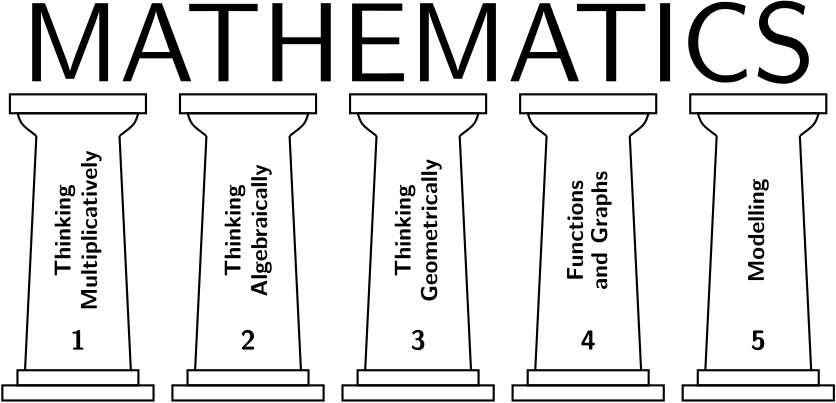
In a typical school mathematics scheme of learning, an objective like ‘Understand proportional reasoning’ might appear in a list that also contains an objective such as ‘Find the exterior angles of polygons’. While both of these have importance, the first one is far more important and powerful within the subject than the other. Even giving \(10\) times as much weight to the first one is nowhere near enough, and does not constitute an efficient way of distributing learning and teaching energy.
I am not saying we only teach the BIG Ideas, and leave learners to work out all the details for themselves. Certainly not. We teach everything. But I am advocating that we primarily teach the BIG Ideas, again and again, really focusing on getting those ideas deeply understood, so all learners know them inside out. We should expect the BIG Ideas to be where \(90\%\) of the difficulties and misconceptions will lie. And then, having taught those BIG Ideas thoroughly, we can, much more briefly, show learners how everything else they need to be able to do follows, hopefully without too much difficulty, from these.
0.3 The benefits of focusing on BIG Ideas
Teachers of mathematics are often detail-oriented kinds of people, and that can mean they are very good at attending to the smaller picture, but sometimes struggle to step back and think at a bigger-picture level. However, a BIG-Ideas approach such as I am arguing for will not be novel for all teachers. It is what any teacher would do if they had an unusually limited time frame in which to teach someone. Imagine a learner who has missed a large amount of a course due to illness or other personal circumstances, or who is resitting a qualification in limited time to try to obtain a better result. In these situations, the teacher has to prioritise and condense the course down to its essential points, because they simply do not have the luxury of going through every separate detail. I am saying that the kind of thinking involved in doing this, and the practice of distributing teaching time in that kind of way, is likely to be beneficial for all learners.
The approach I will describe aims to be akin to teaching someone to fish, rather than giving them a fish to eat. It is like giving them the keys to the door, rather than opening the door for them every time they need to go through. It takes advantage of the intelligence and ingenuity that children and young people bring to their learning when those things are valued, and which they are less likely to display when merely asked to imitate a procedure the teacher has just shown them. It also takes advantage of the rich commonalities that exist across mathematics. The idea is that, having taught someone to make an apple pie, we do not need to begin from the start when teaching them to make an apple and blackberry pie. We can teach the BIG Idea of pie-making, and then adapt this into its minor variations.
Learning how to deploy and adapt the BIG Ideas into the different situations in which learners will need them is more efficient, more rewarding and more genuinely mathematical than the alternative. It is more like the kind of thinking people do in applying mathematics to real situations and in further study. A focus on a small number of BIG Ideas will enable learners to succeed much better with the \(200\) procedures - and even with \(2000\) or \(20,000\) potential procedures they might encounter in the future. It will give them the best chance of a solid foundation for whatever their future relationships with mathematics might require of them. But it necessitates some rethinking from the teacher, and that is what this website aims to provoke.
0.4 The structure of this website
In the chapters of this website, I tackle the five BIG Ideas, one by one. I sketch out what I see as the most important landmarks and suggest ways to make them as clear and compelling as possible. Then, for each chapter, I go on to show what specific benefits come from a deep understanding of the particular BIG Idea. In many cases, this involves entire topics that can be viewed as being derived from that BIG Idea.
Across the book, all content areas included in school mathematics curricula up to age \(16\) are included, but in an order the reader will probably find surprising. The topics may appear ‘all jumbled up’, but that is what you get what you arrange them by BIG Idea.
I also offer detailed suggestions for problem solving within the context of the chapter’s BIG Idea. The text is punctuated by ‘TASKS’ all the way through that offer ways of working on the ideas. Complete solutions are provided throughout, often in footnotes linking to freely accessible articles containing additional detail, further explanation, and in some cases full lesson plans.
Because the school mathematics curriculum is no small thing, and I want to show how literally everything can be derived from just these five BIG Ideas, there is a lot of material here - too much to fit into a book, which is why I have decided to put it on a website. I don’t want to cherry-pick to present the easiest examples, and leave the reader with the challenging task of figuring out how everything else fits. So, I have aimed to cover absolutely everything, to try to convince you that everything in the curriculum really does fit into one or more of these BIG Ideas.
Everything on this website is free under Creative Commons CC BY NC SA, so please make use of it however you wish.
This work was partially supported by UKRI Economic and Social Research Council [grant number ES/W002914/1] and by Research England via the Centre for Mathematical Cognition.
Notes
Foster, C. (2025). Alternatives to atomisation. Mathematics Teaching, 295, 37–41. https://www.foster77.co.uk/Foster,%20Mathematics%20Teaching,%20Alternatives%20to%20atomisation.pdf↩︎
Foster, C. (2014). Mathematical fluency without drill and practice. Mathematics Teaching, 240, 5–7. https://www.foster77.co.uk/MT240-14-01.pdf↩︎
Foster, C. (2013). Resisting reductionism in mathematics pedagogy. The Curriculum Journal, 24(4), 563–585. https://doi.org/10.1080/09585176.2013.828630↩︎
This is very much a ballpark number, as it is very moot what should count as an individual, separate ‘procedure’.↩︎